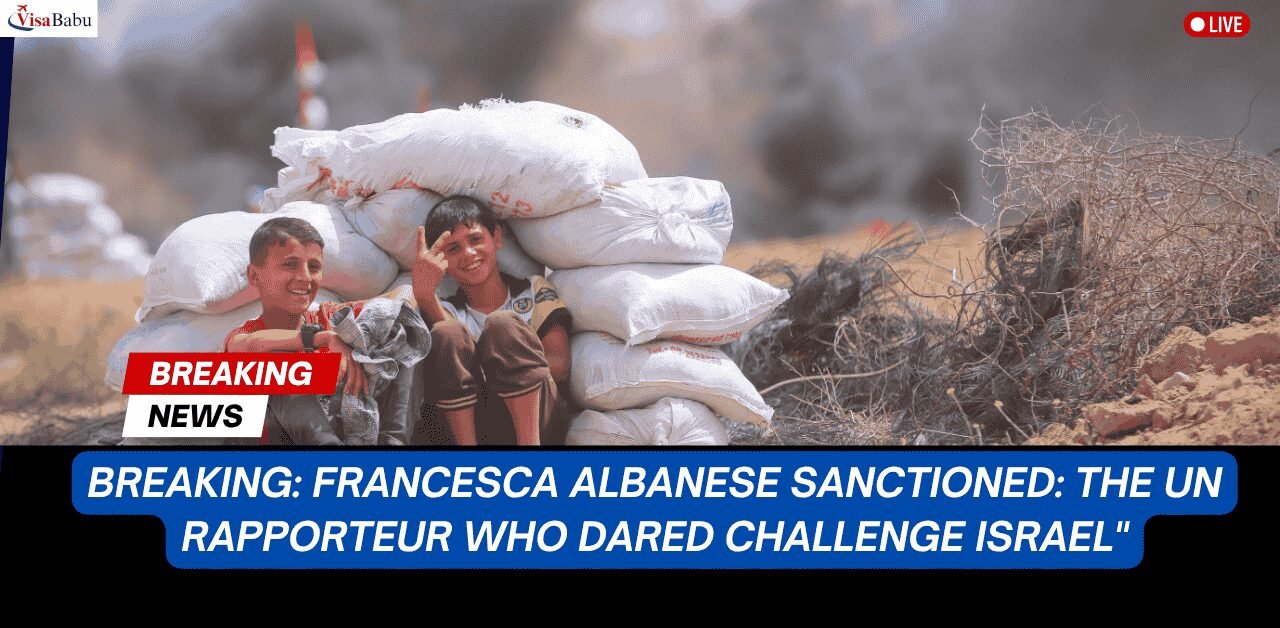
The international community was stunned on July 9, 2025, when US Secretary of State Marco Rubio announced unprecedented sanctions against Francesca Albanese, the United Nations Special Rapporteur on Palestinian territories. This historic move marks the first time the United States has sanctioned a UN human rights expert, sending shockwaves through diplomatic circles worldwide.
The sanctions against Francesca Albanese represent a dramatic escalation in tensions between the US and UN human rights mechanisms, particularly regarding investigations into Israeli actions in Gaza. She is one of the most controversial figures in international law today, with her controversial reports of genocide and corporate complicity.
Who is Francesca Albanese? A Profile of Controversy
Francesca Albanese was born on 30th March 1977 in a small town in the south of Italy, Ariano Irpino. Her rise to the status of one of the most controversial human rights experts in the world is quite extraordinary and contentious, as she began as a representative of a small Italian town in the province.
Educational Background and Early Career
Albanese is an impressive holder of academic credentials that influenced her career path:
- University of Pisa Law degree (honours)
- SOAS University of London Master of Laws in Human Rights
- Georgetown University, Institute for the Study of International Migration Affiliate Scholar
During her ten-year history with the United Nations (2003-2013), she played key roles in:
- UNRWA Department of Legal Affairs (Jerusalem Head Office)
- UN Office of the High Commissioner for Human Rights (Geneva)
- UNDP Morocco, which specialises in governance programs
Personal Life and Connections
Francesca Albanese is married to a World Bank economist, Massimiliano Cal, who works in Tunisia. The two are parents to two children. Another complication of the sanctions has been his husband being a high-ranking official at the US-sponsored World Bank, though this does not automatically subject him to the sanctions.
The Path to UN Special Rapporteur
On May 1, 2022, Francesca Albanese became the first female Special Rapporteur on the occupied Palestinian territories. This three-year mandate, subsequently prolonged until 2028, would turn out to be one of the most controversial in the history of the UN.
Key Responsibilities and Mandate
Francesca Albanese, in her function as UN Special Rapporteur, was entrusted with:
- Exploring the breaches of international law principles by Israel
- Surveillance of the human rights situation in the occupied Palestinian territories
- The UN Human Rights Council is reported to annually
- Public evaluation and visits to sites
The Genocide Allegations That Shook the World
Francesca Albanese was widely noted worldwide because of her daring accusations towards the Israeli practices in Gaza. She has consistently reported that Israel is guilty of genocide against Palestinians.
Timeline of Controversial Statements
| Date | Statement/Report | Impact |
| March 26, 2024 | Reported Israel’s actions in Gaza “amounted to genocide” | First formal genocide allegation |
| January 2024 | Called Gaza war “the monstrosity of our century” | International media attention |
| July 3, 2025 | Accused Israel of “one of the cruellest genocides in modern history” | Prompted US sanctions consideration |
The “Economy of Genocide” Report
On June 30, 2025, Francesca Albanese published her most controversial report, listing more than 60 companies that she said were involved in what she called the transformation of the Israeli occupation economy into an economy of genocide.
The report identified major corporations, including:
- Microsoft
- Alphabet Inc. (Google)
- Amazon
- Lockheed Martin
- Airbnb
Corporate Complicity Allegations
The report explained how these companies supposedly:
- Sold military technology to Israeli troops
- Benefited in the settlements of illegitimacy
- Surveillance systems that were enabled in the occupied territories
- Infrastructure that is sponsored in military activities
The US Sanctions: An Unprecedented Move
On July 9, 2025, the US Secretary of State, Marco Rubio, imposed sanctions on Francesca Albanese under Executive Order 14203. The sanctions are:
Specific Sanctions Imposed
- Freezing of assets of any holdings in the US
- United States travel ban
- US persons and company business prohibition
- European financial institutions face secondaries sanctions risk
Official US Justification
Rubio said Francesca Albanese:
- “Vomited out unashamed antisemitism”
- “Public support of terrorism”
- “Exposed to open disdain of the United States, Israel and the West”
- Engaged in “illegal and disgraceful attempts” to bring the ICC into action
International Response and Support
The case of Francesca Albanese has caused a lot of international response, with most people coming out in support of her work and criticising the American move.
UN System Response
The Special Procedures Coordination Committee of the UN issued a call for condemnation in which it said:
- The sanctions are an indication of a perpetual attack on the UN system
- Francesca Albanese was simply fulfilling her mandate
- The step compromises human rights, justice, accountability and the rule of law
Academic and Legal Community Support
Several human rights groups and jurists have come to the defence of Francesca Albanese, citing that:
- Charges of antisemitism are an illegitimate stigmatisation of her.
- Her job adheres to the principles of international law
- The sanctions established a perilous precedent of UN independency
Albanese’s Response to Sanctions
Francesca Albanese has been defiant against the US sanctions she dubbing them as being obscene and calculated to undermine my mission.
Her Public Statements
In response to the sanctions, Francesca Albanese stated:
- I will keep on doing what I have to do.”
- The sanctions will come as punishment for having revealed a genocide
- They did not dispute me on facts.”
- The relocation is a form of intimidation that is similar to that employed by the Mafia.
Previous Controversies and Criticisms
During her service, Francesca Albanese has been criticised, and her opponents have accused her of bias and misbehaviour.
Financial Misconduct Allegations
UN Watch, a Geneva-based organisation, filed complaints alleging:
- The requests to pay illegally on behalf of official work
- Bypassing UN payment bans
- Sending honorariums to research assistants
Antisemitism Accusations
Francesca Albanese has been criticised for:
- Convicting Israelis of being Nazis
- Whitewash of Hamas atrocities
- Refuting the fact that the October 7th massacre was anti-Jewish
These accusations led to condemnation from France and Germany, making her “the first UN human rights expert in history” to face such criticism.
The Broader Implications
The sanctions imposed on Francesca Albanese have broad implications for international law and the independence of the UN.
Impact on the UN System
| Area | Potential Impact |
| Special Rapporteur on Independence | Chilling effect on future reports |
| US-UN Relations | Further deterioration of cooperation |
| International Law Enforcement | Weakened accountability mechanisms |
Precedent for Future Cases
The sanctions establish a concerning precedent where:
- Influential countries can punish UN professionals in case of adverse reports
- Political retaliation is meted out on human rights investigations
- The mechanisms of international law are put under pressure bilaterally
Academic and Professional Achievements
Despite the controversy, Francesca Albanese‘s academic contributions remain significant:
Publications and Recognition
- Cofounder of the book “Palestinian Refugees in International Law” (Oxford University Press, 2020)
- International Stefano Chiarini Award (2023)
- The 2024 UN Person of the Year PassBlue
- Award of the Dries van Agt prize (2025)
Teaching and Lecturing
Francesca Albanese continues to:
- Speak at European and Arab universities
- Supervision of master’s theses at the University of Bethlehem
- Attend foreign conferences on Palestinian matters
The Future of Her Mandate
Irrespective of the sanctions, the mandate of Francesca Albanese, the core of the UN Special Rapporteur, remains up to 20289. She was prolonged by the UN Human Rights Council even though pro-Israel factions were strongly against the move.
Ongoing Challenges
Francesca Albanese faces several challenges moving forward:
- Travel restrictions because of US sanctions
- Limited finances exchanges
- Political intimidation among various governments
- Family security issue for her family
Francesca Albanese is probably one of the most debatable figures of international human rights law nowadays. The United States’ unprecedented sanctions on her are a new era in the current clash between national and global responsibility systems. Historical justice will perform the final verdict of her work, or of whether it was a biased activism, time will tell, and yet her contribution in defining the debate on the rights of the Palestinians and International law cannot be denied.
The case of Francesca Albanese provokes the most basic questions of whether international institutions can be independent and how much it can cost to tell the truth to power in a more polarised world. The international community will be keen to find out whether justice and accountability will withstand any political strain caused by the most influential countries in the world as she goes on with her mandate in spite of the sanctions.
For more updates like this, please visit: visababu.com
Frequently Asked Questions(FAQs)
Q: What are the particular sanctions that the US has imposed on Francesca Albanese?
A: The US has blocked any asset that Francesca Albanese might have in the US, blocked any US person or company from trading with her, and now Francesca Albanese cannot visit the United States. The sanctions came in the form of Executive Order 14203.
Q: Why did we sanction Francesca Albanese?
A: Secretary of State of the US, Marco Rubio, said Francesca Albanese had been sanctioned because of her illegitimate and shameful action to bring the International Criminal Court action against US officials, companies, and executives. The US also accused her of being antisemitic and a terrorism aid.
Q: What education did Francesca Albanese get?
A: Francesca Albanese earned an honours degree in law at the University of Pisa and a Master’s degree in human rights at SOAS University of London. She is also the Affiliate Scholar of Georgetown University Institute of the Study of International Migration.
Q: Which companies did Francesca Albanese mention in her genocide report?
A: In her report, Francesca Albanese listed more than 60 companies, including such big US corporations as Microsoft, Alphabet Inc. (Google), Amazon, Lockheed Martin, and Airbnb. She blamed these firms for colluding in what she called the economy of genocide in Israel.
Q: What has been the reaction of the UN over the US sanctions on Francesca Albanese?
A: The UN Special Procedures Coordination Committee wrote that it was deeply concerned with the sanctions, which they termed as an attack on the whole UN system and its main principles of human rights, justice and accountability. UN High Commissioner of Human Rights Volker Turk urged the immediate reversal of the sanctions.
Q: Is Francesca Albanese the first UN officer to be sanctioned by the US?
A: Yes, the first UN human rights expert sanctioned by the United States is Francesca Albanese. The unprecedented exercise has caused a shock in the international diplomatic arena.
Q: What is Francesca Albanese’s current mandate, and when does it end?
A: Francesca Albanese serves as UN Special Rapporteur on the occupied Palestinian territories, a position she has held since May 1, 2022. Her mandate was extended until 2028 despite significant opposition.